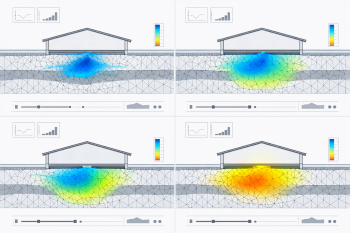
Vapor intrusion is a complex multifaceted process influenced by the soil gas transport dynamics, building characteristics, pressure differentials, and temporal variability. Assessments of indoor air and vapor intrusion depend on an integrated interpretation of conceptual site models, environmental data, and predictive modeling to determine the presence, magnitude, and pathways of vapor migration.
Vapor intrusion modeling utilizes mathematical and numerical techniques to assess the migration of volatile contaminants from subsurface sources into the overlying structures. These models enhance understanding of attenuation mechanisms and the potential indoor air exposure under varying site conditions.
AA GeoEnvironmental provides a thorough review of indoor air and vapor intrusion models to ensure sound conclusions and transparent documentation.
Soil gas migration occurs as a result of concentration gradients, pressure differentials, utility corridors, and fractures, which facilitate soil gas diffusion and advection. Pressure differentials between indoor spaces and the subsurface, induced by HVAC systems, temperature gradients, and building airtightness, significantly influence vapor entry rates. Vapor intrusion is a dynamic process; seasonal variations, groundwater fluctuations, and building operations can enhance the variability in measured concentrations.
Vapor intrusion assessments integrate multiple lines of evidence, including:
Subsurface soil and groundwater data.
Soil gas and sub-slab vapor measurements.
Indoor air sampling results.
Building construction and foundation details.
Conceptual site model development.
To ensure results reflect site-specific conditions and uncertainty, AA GeoEnvironmental reviews how these data are acquired, analyzed, and integrated.
Vapor intrusion evaluation presents several practical challenges:
Short-term sampling may not capture long-term exposure conditions.
Indoor air quality may be affected by background sources unrelated to subsurface contamination.
Data gaps or inconsistent sampling designs can bias interpretation.
Screening-level assumptions may over- or under-estimate risk.
Independent technical review is particularly valuable for identifying these limitations and clarifying confidence in vapor intrusion conclusions.
Mathematical and numerical vapor intrusion models translate subsurface contaminant concentrations and transport processes into predicted indoor air concentrations. Vapor intrusion models are useful screening and their practicability depends on:
Appropriateness of assumptions relative to site conditions.
Quality and representativeness of input data.
Alignment between model complexity and decision needs.
Transparent communication of uncertainty.
Models should support, not replace empirical data and professional judgment. AA GeoEnvironmental provides technical review of model assumptions, inputs, parameter sensitivity, data gaps, uncertainty, and conclusions drawn from vapor intrusion modeling.
What this Service Is
Objective evaluation of indoor air, soil gas, sub-slab, and groundwater data.
Assessment of data representativeness, variability, and uncertainty.
Technical review of vapor intrusion screening tools and numerical models.
Evaluation of whether conclusions are supported by data and assumptions.
What this Service Is Not
Conduct indoor air, soil gas, or sub-slab sampling.
Design or install vapor mitigation systems.
Prepare regulatory compliance determinations or approvals.
Certify that a site is safe for occupancy.
Responsibility for compliance, mitigation, and implementation remains with the client and their retained consultants.