
Infrastructure & Geohazards
Evaluations of infrastructure and geohazards focus on the interplay between engineered systems—such as buildings, utilities, transportation corridors, dams, levees, and subsurface structures—and the natural earth processes that could jeopardize their stability, functionality, or long-term safety. These hazards emerge from geological, hydrological, and geotechnical conditions that evolve over time or are triggered by natural or anthropogenic stressors.
AA GeoEnvironmental offers a thorough review and interpretation of geohazard evaluations related to infrastructure, aiding developers, consultants, owners, insurers, and legal or financial stakeholders in making well-founded decisions. This is accomplished by ensuring that conclusions are substantiated by the presented data and that uncertainty and residual risk are effectively communicated.
Infrastructure geohazard reviews are often used to support:
- Development feasibility decisions.
- Engineering design inputs.
- Legal and liability assessments.
- Lender due diligence.
- Insurance underwriting.

All infrastructure is fundamentally founded on or within geological materials, whose behavior is determined by stratigraphy/lithology, soil/rock strength, natural/anthropogenic stress changes, and groundwater conditions. Understanding the complex relationship of these factors with engineered systems is crucial for evaluating vulnerability and risk.
Geohazards are driven by physical and hydrological mechanisms, including:
- Gravity-driven mass movement.
- Groundwater flow and pore-pressure changes.
- Material weathering and degradation.
- Seismic and vibrational loading.
AA GeoEnvironmental assesses whether these processes have been accurately identified, characterized, and integrated into technical evaluations.
Geohazards are often site specific, time-dependent, and sensitive to data resolution and underlying assumptions. Our review focuses on the extent to which uncertainty is recognized, constrained, and effectively communicated in reports and conclusions. Key geohazards that affect infrastructure include slope instability and landslides, settlement and subsidence, expansive or collapsible soils, the potential for karst and sinkholes, faulting and seismic risks, flooding, scour and erosion, impacts from groundwater rise and drawdown, as well as permafrost and freeze-thaw degradation.
AA GeoEnvironmental reviews technical documentation related to these hazards, focusing on the interpretation of existing investigations rather than conducting new site characterization.
Our structured review mechanisms include:
Ground & Slope Stability
- Soil and rock shear strength assumptions.
- Factor of safety calculations.
- Groundwater influence on stability.
- Sensitivity to loading or grading changes.

Settlement & Subsidence
- Compressibility assumptions.
- Groundwater withdrawal or recharge effects.
- Historical land use influences.
Hydrologic & Hydraulic
- Surface water–groundwater interaction.
- Flood recurrence assumptions.
- Drainage system adequacy.
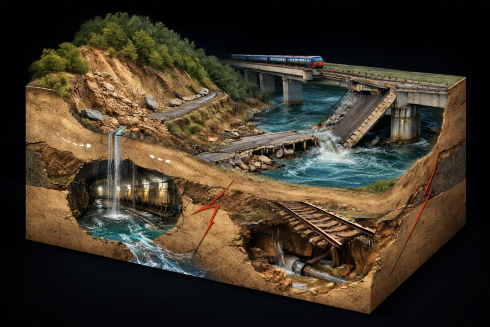
Seismic Effects
- Ground motion assumptions.
- Liquefaction screening logic.
- Structural vulnerability implications.
AA GeoEnvironmental reviews the conceptual soundness and internal consistency of these mechanisms given the available data.
What this Service Is
- Review of geotechnical, geological, and geohazard reports.
- Consistency checks between geology, hydrology, and engineering conclusions.
- Evaluation of assumptions, interpretations, and uncertainty.
- Support for detailed documentation and smart decisions.
What this Service Is Not
- Field investigation, testing, or drilling.
- Geotechnical or structural design.
- Construction oversight.
- Regulatory approval or certification.
Decisions regarding field data gathering, implementation, and adherence to regulatory standards are the clients’ purview.